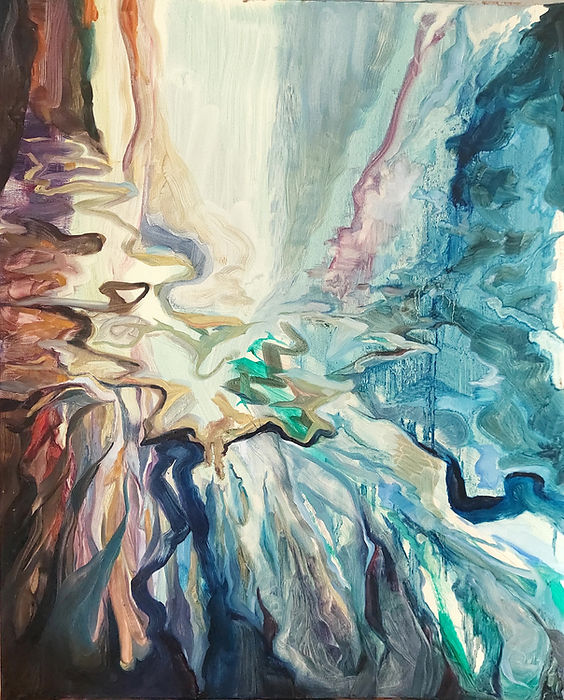
Sofia Rafaella Greaves


G, 196Hz
Painting sound
Work in progress. Oil paintings, 80 x 120cm. Solo exhibition, 2027-8
A series of paintings. The paintings are based on geometric shapes I generate by playing my violin into an oscilloscope. These figures were discovered in the 19th century by a French scientist Lissajous who showed that each musical note and interval has a unique shape, and used this understanding - that there could be a perfect "A" - to standardize tuning, or pitch (Hz), in the world of music. Consequently, sound could be represented as a series and sequence of graphs.
However, these figures are not just scientific graphs; they are also images with a character of their own and shapes how sound is understood. My paintings explore this interaction between sound, technology and representation. I become an oscilloscope, making brush strokes in mimicry of the technology and its fading paths, frequencies, amplitudes. My violin becomes a machine. I introduce colour and set the notes in the context of others. Each painting offers a new perspective on sound by creating visualisations of well known repertoire, and by drawing out the gestural and emotive aspects of these "standardized" forms. It is a kind of reverse synesthesia with a polyphonic visual language inspired by artists such as Hilma af Klint and Paul Klee. Some examples are below.
Beginning a painting. Passage, Mendelssohn Violin Concerto in E Minor. Op. 64
Beginning a painting. Stills, Bach Cello Suite in G played on the Viola.
Indicative work


.jpg)
.jpg)