

Moving to Norway
When we arrived in Norway it was -21 degrees, and last week it was 23 degrees, which is nearly 50 degrees temperature difference.
We came by train and ferry. We expected the ferry to be like the Dover to Calais but it turned out to be a cruise ship with bingo, quiz, dance competition, cocktails, unlimited buffet and sauna. You can catch this ferry from Copenhagen and we arrived in the Oslo Fjord at 10 with the sunrise, and the boat broke through sheets of ice, and it was a blue sky, and it had snowed overnight.


After that, the sun came out after 2.5 weeks of white which is the weather I experienced from January to March. Parents pull their children to school on sleds and collect at zebra crossings. Men play ping pong in the park with loud speakers even when it is snowing. I exclusively wore black. The sun came up at ten. We motivated ourselves with pastries. It was very difficult to wake up. This is all confirmed by supermarket items.


In Norway I have to use Nivea 48 hour night cream on my face twice daily and a French woman told me I look great for 32, but I was also ID'd for an Irish coffee so I am unsure about this outcome overall. We arrived at a speeds I could understand, and it felt enormous the distance we travelled. It was the second week of January, and we swam in the sea which was warmer than the air. There is a disco sauna, friends came to visit, and we ate buns. After that everybody left, I went to a gig on my own and was trampled by Norwegian men.
The Vikings came to Britain in 8-11 century. They gave us words like chin and sky, except in Norwegian those words mean cheek and cloud. Norway has over 1300 dialects due to its islands, mountains and 1800km length which is double that of the UK. There are actually two official Norwegians, Nynorsk (New Norwegian) and Bokmål. Both are relatively young. They were created when Norway became independent from Denmark on 17 May 1814. Before this, Norwegians officially spoke Danish. Whereas Nynorsk was created by amalgamating dialects to promote Norwegian cultural identity, Bokmål was created by adapting Danish to Norwegian pronunciation.
Jeg heter Sofia og jeg snakker norsk. ikke veldig bra, A2.


I probably naturally gravitated towards the most totalitarian looking building and in the city hall there are the most stunning murals I have ever seen depicting trolls, the Norwegian constitution and its roots in the French Revolution. The building was constructed during the brutal Nazi occupation of Norway (1940-5). It is covered by over 30 metres of murals about the resistance. Outside there are wood carvings of Norse mythology. For example, “Volund the Smith has Vengeful Thoughts.”
Volund the Smith has Vengeful Thoughts
The evil and greedy King Nidud (evil) captures Volund, severs his hamstrings and orders him to forge costly jewellery on a deserted island. The King has stolen a ring from Volund and given it to his own daughter Bodvil. Now the ring is broken in two and Bodvil secretly travels to meet Volund in order to have it forged into one whole ring again. The King’s two sons are tempted to the island by all the gold the smith has. Volund cuts off the boys’ heads, mounts their skulls in silver and sends them to King Nidud as drinking vessels. From their teeth he makes a brooch to Bodvil and he mounts their eyeballs as precious stones in a piece of jewellery for the Queen. Finally he rapes Bodvil and she becomes pregnant with his child.
Which I did not think the woodcut accurately reflected.


I watched a film last night about Birkebeinerrennet the cross country skiing race. It is obligatory to carry a 3.5kg backpack because in the 13th century, during the civil war, King Haakon Sverresson had an heir who needed to be carried to safety over the mountain via cross country skiing. And now competitors must all carry 3.5 kg backpacks to symbolise making that dangerous journey which culminated in the crowning of Haakon Haakonsson (the son), the end of the civil war, and the “Golden Middle Ages”. It is a 54km race and the first 34km are all uphill reaching 1000 metres above sea level. Yesterday, I competed in a relay running race with 82,000 people and at the end we had sugar free Coca Cola. I think these are good vignettes of Norway so far.
There are also many ducks in Oslo. I named a bridge Duck Paradise where the river was frozen which is apparently great for ducks because they are safe from heavy predators. But now the ducks are gone. I walk that way to work and in the morning the snow is exciting. Later the snow half melted and became grey with cigarette butts, and I was wading through Norwegian admin.


Much key administrative information was delivered via emails with capitals, ultimatums, hyperlinks and different fonts. I was extremely lonely. I industrialised my crochet output, watched the olympic ice skating, and made wonky snoods. Now it is May, and everything is great because I live in a beautiful flat with a wood burner rented to me by a space rocket engineer and I can see the sea, the snow behind it, and have a communal garden with a huge Norwegian flag.
I spilt many tears over the lonely situation and one Sunday I went to get a pint and sat at the bar, which is normally how to make friends, and met an artist from Manchester who writes musicals. I left my number in biro on a napkin, and never heard back.
I met a gorgeous French man at a techno bar called Marvin, who is a ballroom dancer. He invited me to meet his housemates. I brought homemade aged dough cookies which was a mistake because they are pastry chefs. They told me that there are no baguettes in Oslo. “it is Dis-Gust-ing.”
I went cross country skiing and found the way myself, and I was proud because it was cold and difficult and I ate thin sausages in potato pancakes, which is a national snack. But it was not my favourite.
I joined a rock carrying cult, which involves carrying heavy backpacks for 10km whilst chatting, and it was life saving at the time, but requires commitment on a Saturday.
We made a Feeld profile so that I could meet people, but I deleted it after 2 days because I only got offers to be my sugar daddy.
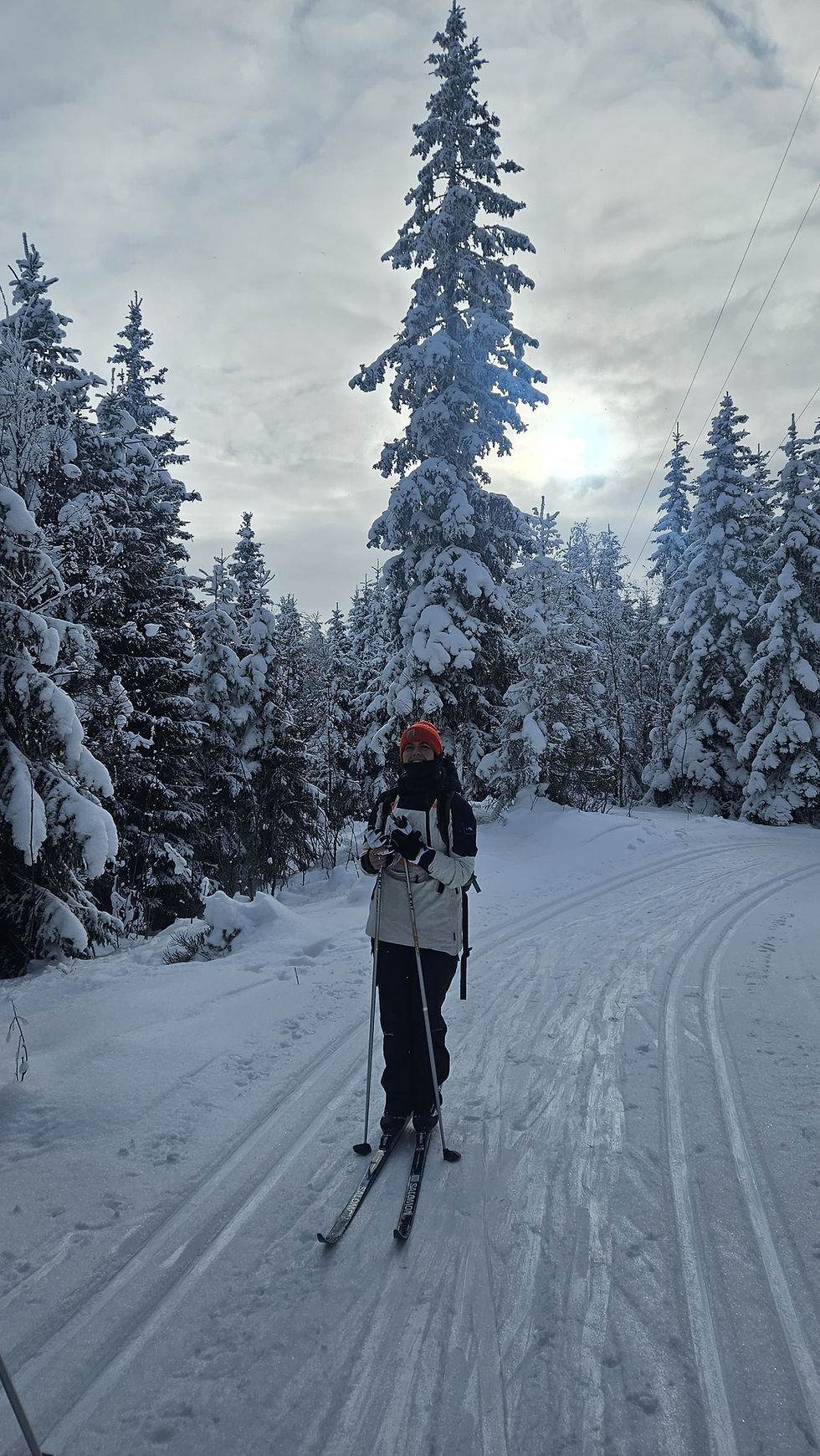
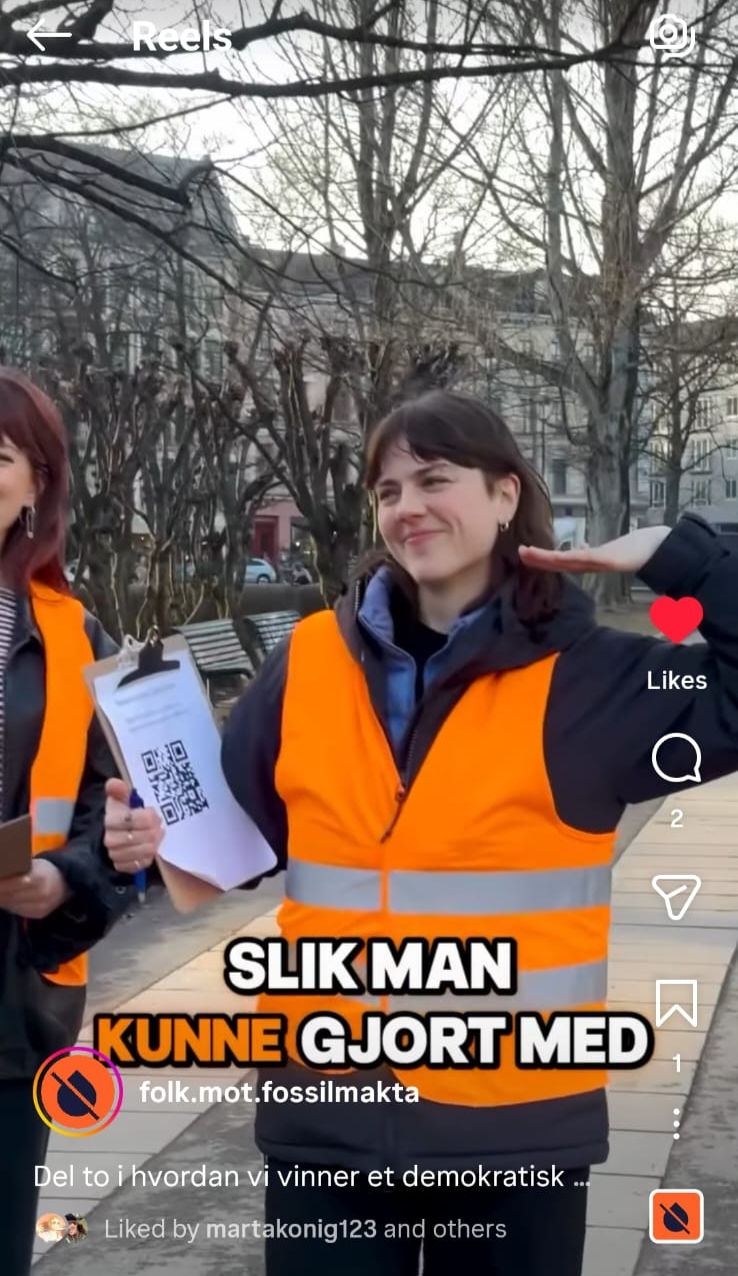
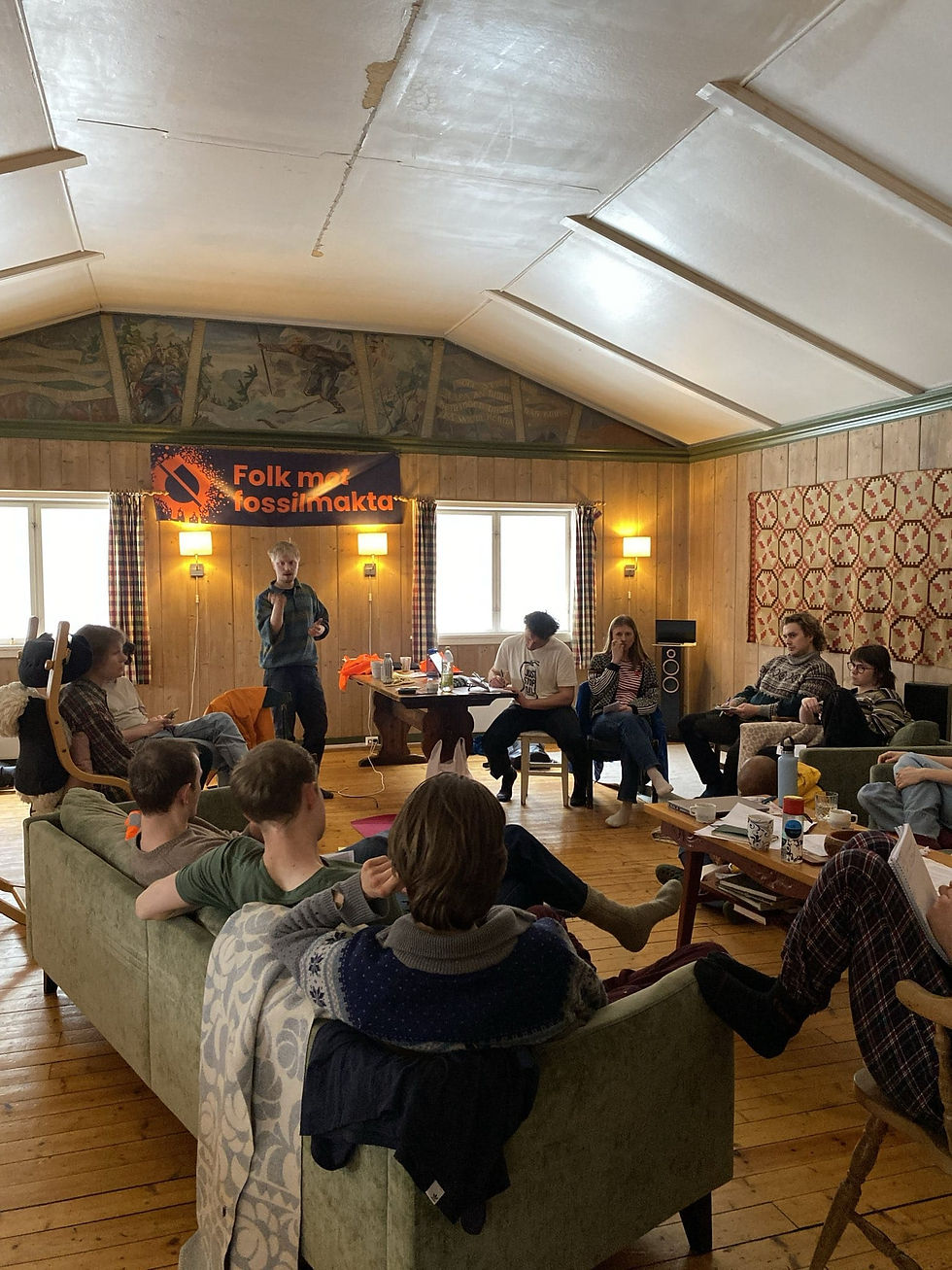
Most significantly, I joined an activist group called Folk mot Fossilmakta (people against fossil fuels). They led a successful campaign to end fossil fuel sponsorship of skiing and other winter sports. We spent two days in a cabin preparing for the next campaign: democratise the Oil Fund. We slept in bunk beds, cooked communally, learnt mobilisation strategies and went for walks.

The day before Christmas in 1969, it was announced that Norway has the largest oil field in the world. A fund was set up as a safety net: it would store the wealth generated by Norway´s natural resource for the Norwegian people. In the meantime, the fund would be managed by Norges Bank and grown through reinvestment. It is obligatory for the fund to be invested over seas, and it is therefore extremely influential in shaping global dynamics and what is possible in the world. For example, 500 million is invested in Ryanair.
Today, it is the world´s largest sovereign fund and totals over 21,268 billion kroner (2.1 trillion dollars). This money is intended for the Norwegian people long term and is referred to as “the pension fund.” The investment strategy is currently being reviewed after criticism that Norges Bank did not take ethical recommendations concerning weapons, mining companies and conflict. A survey by Response Analysis returned that 73% of Norwegians would accept a lower return on investment in return for a more ethical and democratic strategy. But currently Norwegians have no say about how the (their) money is invested. It could be done, for example, through citizens’ assemblies which bring together a representative sample of the population to deliberate investment guidelines. They are given expert recommendations to inform their decisions.
This has been done before, the 2025 Norwegian Citizens' Assembly on the Oil Fund (Framtidspanelet) convened 60 citizens and they recommended that the fund should prioritize sustainable investments, renewable energy, and global development instead of maximizing short-term profits.
But this is extremely contested,


On my first and only day of petitioning a man told me that “minority rule was spreading like a virus” that I should not tell Norwegians what to do, and that “Norway should make itself big and strong.” It upset me because I am quite sensitive and because this misunderstands what “minority” and “representative” decision making actually is, as well as the global relevance of the world’s biggest investment fund (which is currently managed by a minority), and my democratic right to express opinions on political issues.
Moving on, at the hut I met Swedish artist Marta König and we will put on an exhibition documenting the campaign by painting portraits of the activists. Activists are normally demonised by the media. I am super happy to return to portraiture in a political way. I will also make a textile of the Oil Fund. It will be embroidered with public opinions and stories collected through conversations on the street. The piece asks people to think of the fund as a saga inherited and passed down through the ages. Who gets to tell the saga of the Oil Fund? Can there be a collective story? What story should be told to future generations?
I concluded that, through art, I can pose these questions even if people think that I should not answer them. And that is how i would like to contribute.
Later, a friend invited me to a wooden hut with carved wooden beams via ferry, and we had cauliflower curry, made fires watched the sea and talked about the birds.


In Norway I spend time comparing Spain, because that was also next to the sea and stunning but an isolated place to live. I had so many adventures waking up by the river or in the mountains but was often desperately lonely. In the last months living there I took 24 flights home, moved flat three times, lived somewhere without a flushing toilet, and was assaulted by a man in a lift. Oslo feels different and less destabilising not only because it is a well-connected city but also because a large part of me remains the same when I move between countries. So much of who you are depends upon the language you are speaking, and I am mostly speaking English on either side.
It is a reality for early career academics to move around and be turbulent because there are no permanent contracts at universities, partly due to Brexit agreements not funding humanities in the United Kingdom. This is mostly due to the belief that we need to make money and products out of research, for which science and technology, and not the arts, are seen to be important tools. But the arts, humanities and social sciences investigate the world in ways which science cannot, and bring a critical eye to science which is useful because science itself cannot fully know its blind spots. This is not the opinion of those aggressively defunding the humanities across the globe, for example Elon Musk.
And on the one hand I am really proud because it is brave to move countries and to create your own adventures, and it is really hard to learn new languages and be active in world politics, and on the other I know that for me these choices are less risky because I have the support of my wonderful partner, friends and family, and in a worst case scenario, I could move back to London and live with them.
In Norway, I am working on three ideas over three years. All of them involve making music and finding ways to listen to one another and the non-human world. We will borrow technologies used by scientists to make art, and hopefully that art provides a way of engaging with difficult questions like pollution, and fascism. The focus on listening and music is meant to counteract the aggression, shouting and telling surrounding politics and climate in our time.
1 How can we turn air quality data into sound, and listen to air? Can listening to the air help us to care for it? And how does translating that data into sound help scientists better understand pollution?
2 How can I listen to the non-human inhabitants of the OsloFjord and make music which conveys these perspectives?
3 How can we we engage with the legacies of Fascism by listening? This project will focus on abandoned buildings in Predappio, Italy, and involves recording and visualising their inaudible frequencies, or their "voices."
It is 12 May, and I receive a very Norwegian text. “There will be a flag raising and Ja Vi Elsker by the Sofienberg Music Band at 08.56 in Midtparken. Welcome to a traditional and beautiful start to the National Day. Greetings from the Board”.
Sign the petition to democratise the Oil Fund > you do not have to be Norwegian https://www.folkmotfossilmakta.no/oljefondet

Notes
For film about Nazi occupation, watch No. 24, or Gold Run
Nynorsk was created by amalgamating dialects to promote Norwegian cultural identity. In contrast, Bokmål was created by adapting Danish to Norwegian pronunciation. I am learning Bokmål because it is more common.

Comments